An analysis by Alanna Shaikh of how we tend to react to critics. Of course it is easy to take down an ill-conceived initiative like 1millionshirts, but it is important to reflect on whether we react much better when we are the focal point of criticism.
Wired Magazine writes about the logistics of the Haiti response as a spring board for a wider discussion of disaster response logistics. It’s a bit overly endowed with ‘human interest’, but on the whole I would say that it is a very good introduction. “Organizing Armageddon”, though? (H/T Cynan Houghton.)
Alex de Waal writes a great article on the ‘humanitarians’ tragedy’: the inescapable cruelties that come with our work. Sadly, it is hidden behind a paywall, but I recommend it highly if you do have access.
I am trying to find somebody who can tell me more about the cooperation between Handicap International and Atlas Logistique. Email to their general address goes unanswered. So if you work with/for them or know somebody who does, could you please ask that somebody in the know contacts me?
As I have written before, health logistics as a discipline tends to ignore the impact of the logistics of daily life on health. Possibly the clearest example is how physical access to primary health care impacts on health.
What do you do when you are seriously sick? Well, most of us in the developed world would go to a doctor. But what if that doctor is a four-hour trip away? Even here in Australia, a developed country by any account, access to health care is much worse in remote and rural areas than in the cities, and the health outcomes are as can be expected. Similar results have been shown in studies in other developed countries.
Solutions obviously need to be found, and some are already being implemented. Foremost, we need to concentrate more of our preventative efforts on less accessible areas. Of course, that is easier said than done: the same issues confronting a patient searching medical treatment, are hindering outreach and health education efforts — and when it comes to e.g. water and sanitation efforts, the logistics issues are even worse.
Another way to deal with these issues is by decreasing the distance between patient and health care. There are basically two ways of doing so: by bringing access points to the patients, or by bringing patients to the access points.
The former can be done by more dispersed access points, or by mobile clinics. Both have some serious drawbacks. Peripheral health access points are either unable to cope with more serious complaints, or would have to be impossibly well-equipped in a setting that is resource poor — you cannot put a secondary hospital in every hamlet, definitely not in a resource-constrained setting like a developing country. Mobile clinics can be slightly better equipped and resourced, but are only occasionally available to any given population and hence cannot deal with e.g. many emergencies, simply because they are not there when the emergencies occur; moreover, they are a shocking waste of time for the health care professionals, who spend much of their working hours trekking from one place to the next instead of on patient care.
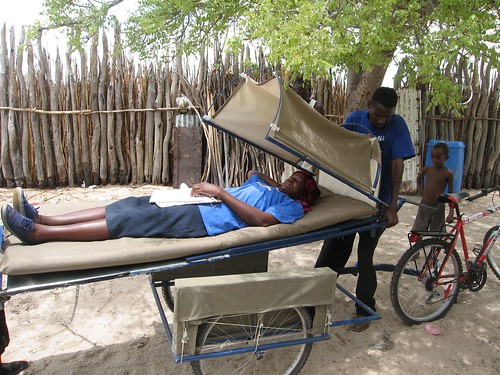
Bringing patients to the health care settings is something that is rarely done. In developed countries we do so using individual patient transport (e.g. ambulances or commercial patient transport), but that is not an option for developing countries. Another way would be to use communal patient transport. Imagine a bus (or animal-drawn cart, or a caravan of donkeys or camels…) making scheduled rounds along a number of reasonably short circuits, picking up patients and delivering them to the nearest health care facility, and returning them on the next round after treatment. It would still not solve the problems of emergency care, but for the less acute cases it would bring patients possibly faster and more comfortably, but definitely at less cost for them to the care they need — without wasting a valuable and scarce resource, health professionals’ time.
Obviously there are issues around it that need to be solved, but it seems to be a intriguing possibility with many possible advantages. I know it has been done at very small scales, e.g. in refugee camps and in the immediate surroundings of some health posts here and there, but as far as I know it has never been tried in a larger area (but I would be chuffed to be corrected). High time for a trial, I would say.
And sometimes, just sometimes, I see so much hope in a small newspaper article.
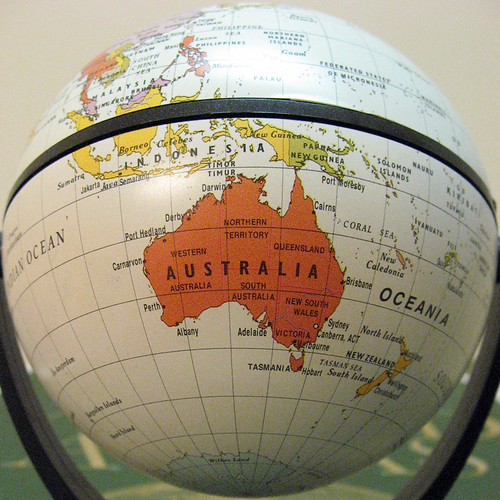
I don’t think that many people will have noticed the almost historical occasion celebrated in a recent article in The Jakarta Post. Indonesia is not the poorest country on earth, yet it is definitely not in the same league as Australia. However, the recent bushfires in the Australian state of Victoria have caused the unprecedented: Indonesia gave international aid to its southern neighbour. Sure, we are talking about US$ 1 million, which is not a huge amount by any standard of international aid, but just this idea is so hopeful: a country that is still on its way to prosperity and not that long ago was recipient of massive aid, is now able to give some of this same aid to a country that is in the top-20 of the most prosperous countries in the world.
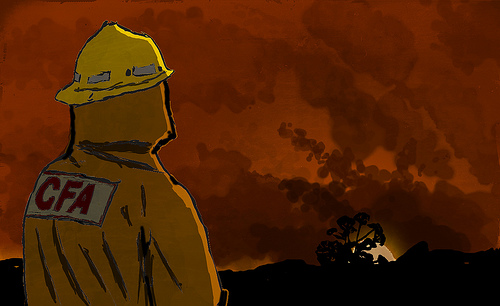
Original artwork by Australian Leon Rice-Whetton, who made this drawing to honour the Country Fire Authority's (mostly volunteer) firefighters. Some rights reserved; see http://creativecommons.org/licenses/by-nc-sa/2.0/deed.en
I think most aid workers see aid as something that we do for others. However, sometimes things can get very close, even uncomfortably so. Fires are raging across much of Victoria, the Australian state in which I live. Hundreds of people have died, and thousands are homeless. An unprecedented aid campaign is under way, with fire-fighters, both military and civilian, being flown in from all over the country, and resources flowing in from all directions — including international aid organisations like OXFAM and Save The Children.
Compared to aid operation in a country like e.g. Sudan, all this is small stuff; but its impact on a country of only 20 million people that has never experienced anything like it, is staggering. The logistics of it is taking up a large slice of the country’s capacity, especially as this capacity is severely impacted by the fires themselves. Luckily, the aid operations seem to be going relatively smoothly.
I live in a relatively safe part of Melbourne myself, but like most Australians my thoughts are continuously with my friends who are not so lucky — and I am greatful for the aid that they receive.